
Broken Church Structures
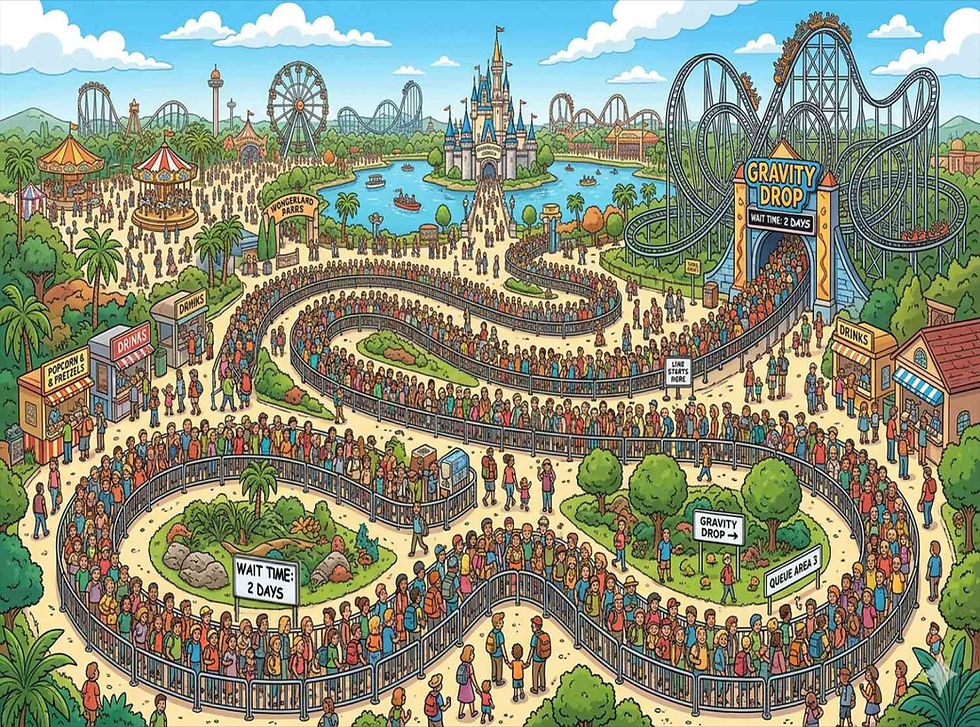
This past week, my wife and I had the pleasure of riding the motion-simulation, Dramamine-inducing rides at Universal Orlando.
In the newest park, the lines for some of the rides were ridiculous: the Harry Potter ride commanded a 210-minute wait at one point.
No thank you. I’m pretty sure I cannot find a reasonable justification for waiting 3½ hours for a short thrill ride, no matter how cool.
But while waiting in line for other rides, I found an interesting emotion arising: a resentment of the people hurriedly walking past me in the Express Pass lane. My friend Dan Henry and I jokingly referred to them as the “rich people.” The added cost is typically as much as the ticket itself, meaning that for a family of four, you need a second mortgage for that benefit.
Heck, even former Disney CEO Michael Eisner complained about comparable pricing at Disney World:
“I'm not wild about the fact that it is so expensive now to go to Disneyland or Walt Disney World. I'm not wild about the fact that it's harder than ever to have everybody be a VIP at a Disney Park because they're selling certain things.”
To use Disney as an example, the original idea was that anybody—implying the “common” person—could feel like a Very Important Person. It was reasonably accessible.
Back in 1970, admission and a 10-ride Disneyland ticket book averaged $6.25. Today that would be about $53. Compare that to going to Disneyland on a Saturday in June this year: $199. Oh, you drove there and need to park your car? That’s another $40. And let’s forget about the Express Pass option.
That’s about a 350% increase.
Anyway, back to my waiting in line.
This disdain for the people walking past me—and frankly causing our wait times to increase—was a problem for me with that pesky tenth commandment: don’t covet.
Okay, I own that one. But is there more to this?
Let’s take this out of the first-world problem of theme park pricing. Let’s think about it from a wider cultural experience: how do our socioeconomic systems create caste structures that penalize the poor? If architecturally “form follows function,” do the ways in which we broken humans categorize and judge one another facilitate the creation of structures that expedite our American caste systems?
And if we carry that same brokenness into our spiritual lives, how do our churches create structures that label people, perhaps in more subtle ways than how Jesus’ brother accused the churches in the first century:
My dear friends, don’t let public opinion influence how you live out our glorious, Christ-originated faith. If a man enters your church wearing an expensive suit, and a street person wearing rags comes in right after him, and you say to the man in the suit, “Sit here, sir; this is the best seat in the house!” and either ignore the street person or say, “Better sit here in the back row,” haven’t you segregated God’s children and proved that you are judges who can’t be trusted? JAMES 2:1-4 THE MESSAGE
But let’s take this even further than our obvious economic sins.
For instance, have our rigid views of “clergy” and “laypeople” undermined the practical exercise of “equipping the saints” to do the work of ministry?
Pastors are generally surprised when I tell them that most of our weddings and funeral services were performed by laypeople in our church, even when we were a church of 5,000+ with 120 people on staff. Why would we not mobilize the “people resources” in our midst?
Taking a hard look—both philosophically and practically—at our church systems that not only denigrate our fellow image-bearers but limit ministry outcomes is the work of leadership. And only leadership can make the changes that dismantle them.
You might need some Dramamine while you do it.
Dave Workman | The Elemental Group
Want to receive these weekly in your inbox? Subscribe for free here.



Comments