
The Night of Broken Glass
Updated: May 21
At one point in my life, I found myself working as an engineer in a commercial recording studio in Cincinnati.
On off-times, the owner let me use the then state-of-the-art 24-track room to record different friends and musicians.
One was Tim Spransy, a fabulous guitarist—and equally amazing painter (visit his artwork here)—who had done a stint in the Christian rock band Servant back in the day. Tim had a moving, beautiful solo acoustic guitar song called Kristallnacht. You can listen to it in the player below—I encourage you to do that while you read the rest of this.
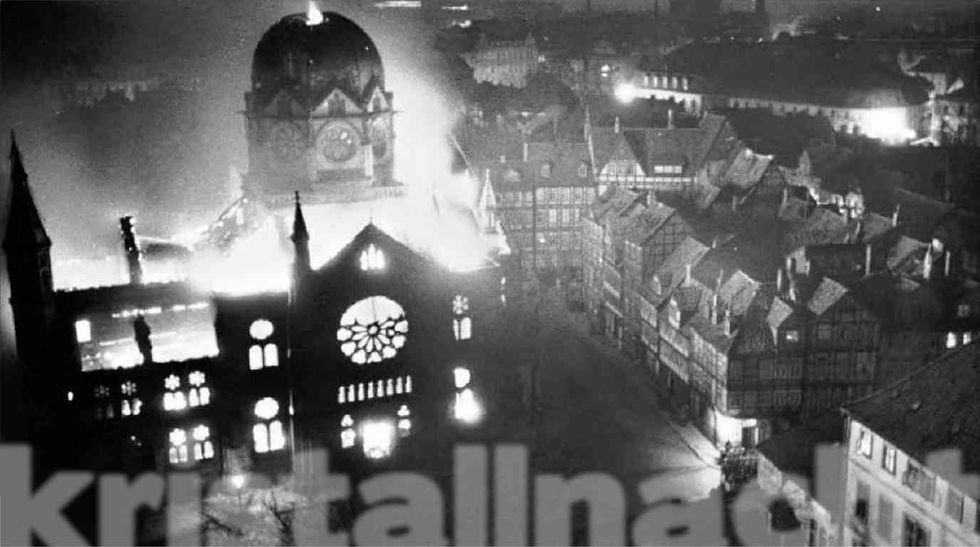
Kristallnacht—Night of Broken Glass—was, of course, the infamous November 9–10 overnight of violent arson and vandalism against Jews in Germany in 1938. Meant to look like a spontaneous reaction to the assassination of a German diplomat by a Jewish teenager in Paris, it was carefully orchestrated by Nazi leadership.
A perfect false flag.
Hundreds of synagogues were burned, thousands of Jewish businesses vandalized, and the homes and apartments of Jewish people were broken into, where they were savagely humiliated, assaulted, and murdered. In the aftermath, thirty thousand Jewish men were arrested and carted off to concentration camps.
Even more bizarrely, the Nazi regime later demanded that the Jewish community pay back one billion Reichsmarks (over $9 billion in today’s dollars) as an “atonement payment.”
But here’s the kicker: the pogrom was intentionally timed to occur on Martin Luther’s birthday.
Bishop Martin Sasse of the Evangelical Lutheran Church celebrated: “On November 10, 1938, on Luther's birthday, the synagogues are burning in Germany.” Later, Bishop Sasse declared, “We would still go on with the Führer even if he closed the church doors before us. In Germany, there is no life except with the Führer... The present-day task of theological science is to provide a religious foundation for the new State ethics.”
Frightening.
Adolf Hitler’s version of Christianity is naturally viewed as appalling today. His narcissistic quest for power, driven by an ideological hatred of “outsiders”—anyone not of Aryan descent—eventually led to a global conflict and the deaths of 70 to 85 million people. It was the bloodiest conflict this planet had witnessed, occurring only about eighty years ago.
From Constantine on, the marriage of State and Church has proven to be disastrous to the cause of Christ. History has shown that when Christians confuse the humility-laden, servanthood message of Jesus for positions of power, even for seemingly altruistic pursuits, they are easily co-opted by unscrupulous leaders who feign a form of Christianity for their own gain.
And in so doing, the true beauty and power of the gospel is always neutered.
Hence, the challenge for leaders is when and where to speak truth to power. Often, John the Baptizer is cited as an example of a “believer” prophetically calling out a leader. It should be noted, though, that John was not attacking the Roman Empire per se, but rather the Jewish governmental leader of Galilee—in other words, his own leaders within his religious construct. In a roundabout way, it seems to pre-echo Peter’s word that even with God’s judgments against humanity, it begins first “in the house of God.”
Perhaps pastors and Christian influencers need to speak to our own tribal leaders—that is, those in our house of faith—about the dangers of cozying up to political leaders and conflating the aims of the State with those of the Kingdom.
Maybe for the priests and prophets among us, that’s the place to start.
Though it is the responsibility of leadership, when leaders shirk that duty, eventually the people will rise up en masse instead.
And that is always a much messier process.
Dave Workman | The Elemental Group
Tim Spransy has graciously permitted free downloads of "Kristallnacht". Click on the "arrow box" on the right of the player and then look for the download icon on the left.
Want to receive these posts weekly in your inbox? Subscribe for free here.


Comments